

An international team of researchers, including scientists from the University of Minnesota and The Ohio State University, has taken a major step forward in precision cosmology. The scientists managed to measure with unprecedented accuracy the primordial abundance of helium that formed in the Universe during the first five minutes of its existence.
The results of the extensive study were published in a series of five papers in The Astrophysical Journal. They provide new clues for understanding the physical processes that took place at the very beginning of the evolution of our Universe.
Time Capsules
According to the Big Bang theory, about 13.8 billion years ago the Universe began expanding from an extremely hot and dense state. This concept rests on three fundamental pillars: the expansion of space, the existence of the cosmic microwave background, and the large abundance of primordial light elements, primarily helium and deuterium.
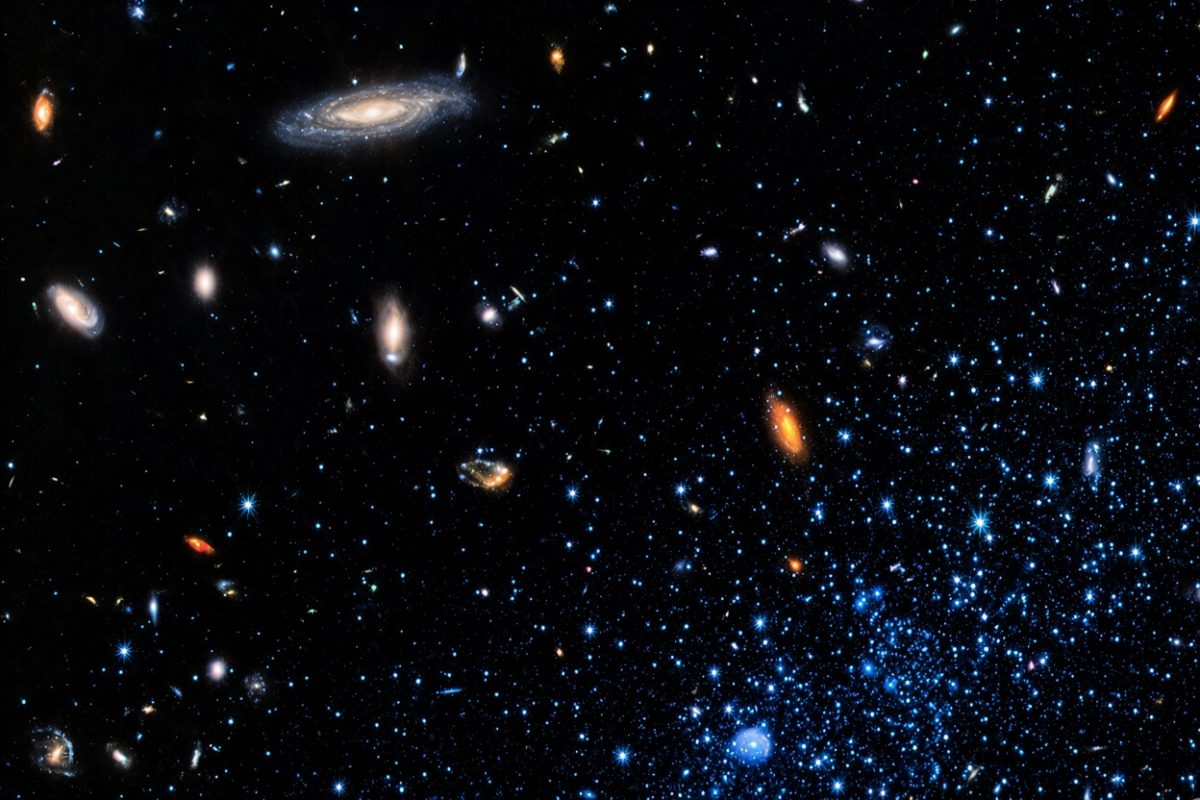
Previously, the helium content was determined using extrapolation — generalizing data collected from observations of a large number of different galaxies. This time, the researchers chose a different approach: they focused on 15 of the smallest, most distant, and most “pristine” galaxies. Because of their chemically unevolved composition, these objects serve as cosmic “time capsules,” having remained in almost the same state as shortly after the birth of the Universe.
A Breakthrough Thanks to MODS Spectrographs
To collect the data, the scientists used 130 hours of observations with the Large Binocular Telescope. A key role in the research was played by the MODS spectrographs, which took 12 years to develop at The Ohio State University.
Using MODS, the researchers simultaneously analyzed more than 10 helium spectral lines and 15 hydrogen lines. This made it possible to compensate for and account for small systematic distortions that had previously been ignored but proved critical for achieving the required precision. As a result, the measurement uncertainty was reduced to 0.5%, which is three times better than all previous scientific standards.
Refining the Standard Model
The data obtained are of enormous importance for fundamental particle physics. An accurate value for the primordial helium abundance allows astrophysicists to precisely calculate the number of neutrino families — the lightest subatomic particles that existed in the primordial hot “soup” of the early Universe.
Such high-precision experiments not only confirm the historical course of cosmic evolution but also put the Standard Model of physics to the test, paving the way for new technological and fundamental discoveries.
Previously, we described in detail the process of the birth of the Universe.
According to phys.org

