

The gas surrounding the supermassive black hole at the center of our Galaxy has turned out to be rich in metals. These were most likely expelled by stars that exploded nearby. The gas resembles many of the stars orbiting the black hole in composition, suggesting that it may have formed alongside them. These findings come from observations by the James Webb Space Telescope.
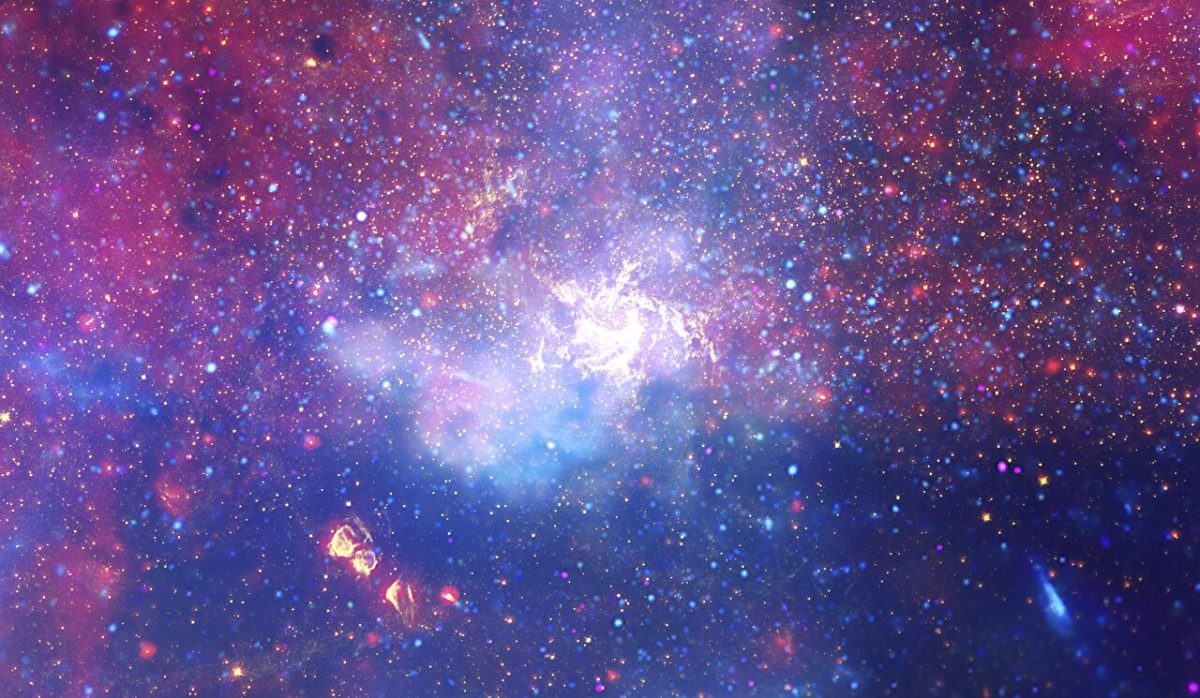
The Metallicity of Gas Near the Black Hole
Astronomers describe metal content using metallicity: the fraction of a material’s mass made up of elements heavier than helium. It is usually compared with the Sun’s metallicity, with these elements accounting for approximately 1.3% of the Sun’s mass.
The gas forms the minispiral, a system of ionized gas streams approximately ten light-years across that orbit the black hole Sagittarius A*. The black hole has a mass of about four million Suns and lies approximately 26,000 light-years from Earth. It is the nearest supermassive black hole, making its surroundings the easiest to observe.

Nicole Ford’s team concluded that the minispiral’s gas is enriched with metals most likely supplied over time by stars exploding near the black hole. Its composition resembles that of many stars orbiting Sagittarius A*. This suggests that the gas and these stars formed at the same time. Estimates of the gas’s metallicity, including those in this team’s work, range from 0.7 to 2.5 times the Sun’s.
The gas is particularly rich in alpha elements, including oxygen, neon, and sulfur, while containing relatively little iron. Alpha elements form primarily inside massive stars and are released into space when those stars explode, so this composition is consistent with the explanation involving supernovae near the black hole. The results were published in the peer-reviewed journal The Astronomical Journal.
Metals Help Gas Cool Faster
The black hole at the Galactic center attracts matter but takes in much less of it, and at a slower rate, than other supermassive black holes, explains Nicole Ford of McGill University’s Trottier Space Institute in a release on phys.org. The luminosity of Sagittarius A*—the total energy emitted each second by matter surrounding the black hole—does not exceed a few hundred times the Sun’s. Heated matter falling toward the black hole could emit far more. For a black hole of this mass, the upper limit at which radiation pressure balances gravity exceeds 100 billion solar luminosities.
Metallicity determines how quickly gas cools. Atoms of heavy elements emit energy through numerous spectral lines, allowing gas rich in these elements to lose heat faster. Cold gas is less supported by its own pressure, making it easier for the black hole to draw it in. The new data do not yet explain why Sagittarius A* takes in so little matter despite the gas’s composition.
Spectra from the James Webb Space Telescope
The data were collected using the James Webb Space Telescope, which operates in the infrared. Its spectra are detailed enough to distinguish the thermal emission of individual gas clouds near the black hole and measure the metallicity of each.
Meanwhile, a group led by Mayura Balakrishnan investigated whether the gas retains traces of flares from Sagittarius A*. In X-rays, these occur approximately once a day on average. The paper was published in the peer-reviewed journal The Astrophysical Journal.
No trace was found. Light takes anywhere from a few hours to ten days to cross the region where the gas emits in these spectral lines, while the ions need more than a week to recapture electrons. As a result, flares lasting approximately an hour are smeared out, and the gas reflects only the average irradiation. This does not mean the flares did not occur; they simply cannot be tracked through the gas.
Nicole Ford believes that comparing observations with computer models of gas evolution over much longer timescales will help explain how the black hole draws in matter. Individual James Webb observing sessions used in Mayura Balakrishnan’s paper lasted between two and seven hours.
