

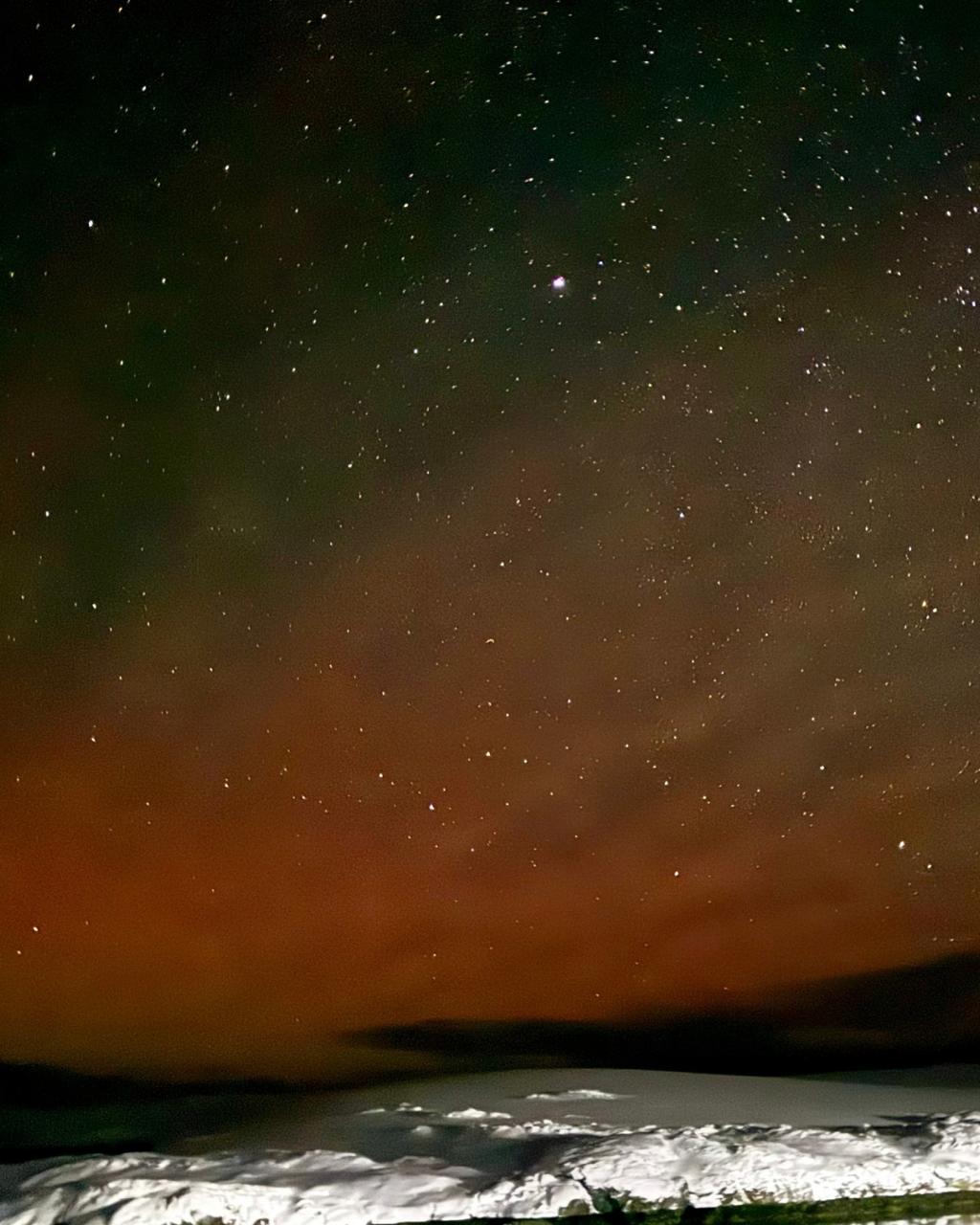
Ukrainian polar researchers photographed the night sky above the Vernadsky Research Base, capturing phenomena on vastly different scales. The images show a reddish aurora glowing hundreds of kilometers above Earth, alongside two neighboring galaxies — the Large and Small Magellanic Clouds — whose light has traveled toward us for hundreds of thousands of years. Photographer Serhii Yakushchenko took the photographs on Galindez Island, off the coast of the Antarctic Peninsula.
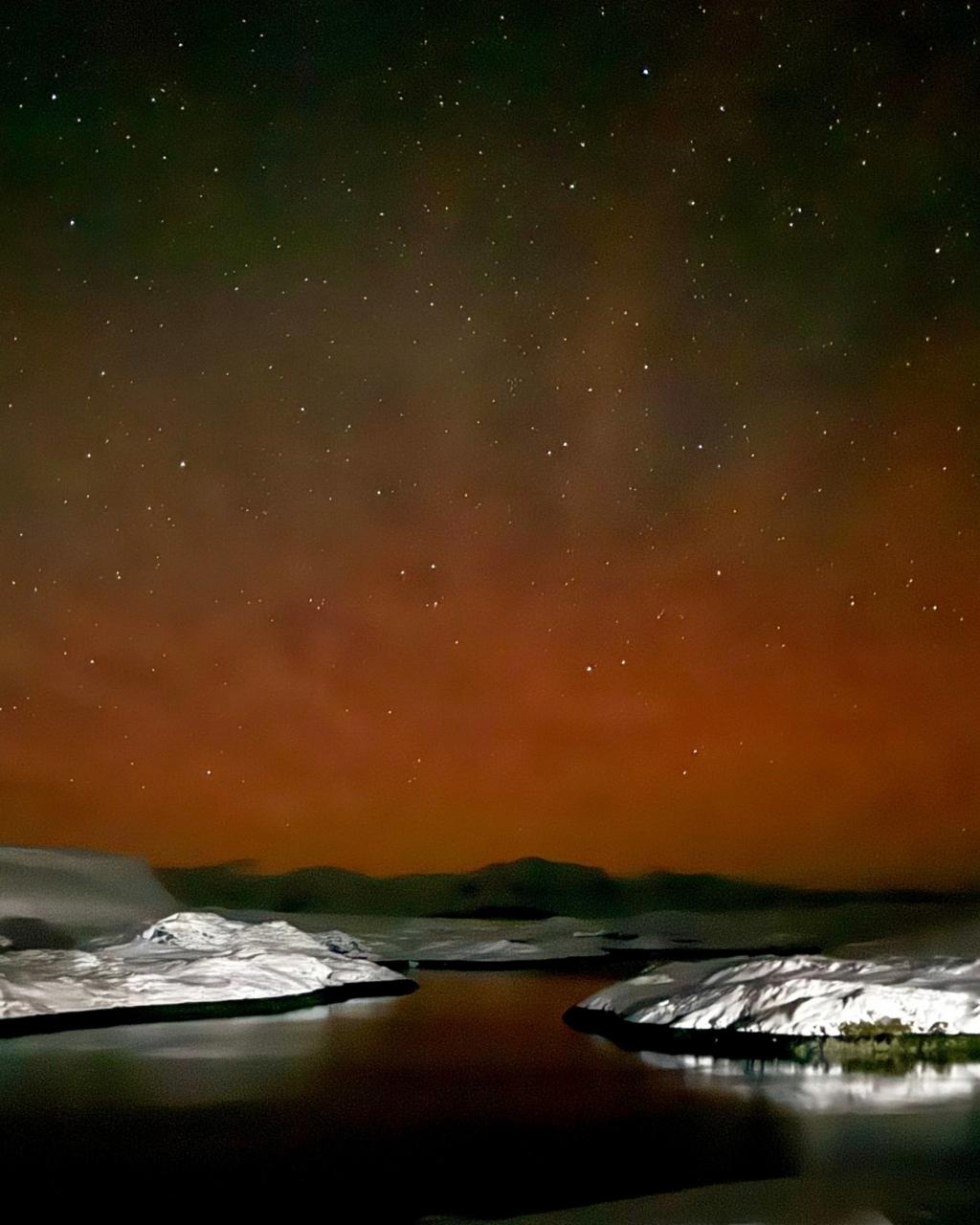
Why is the glow red?
The aurora is commonly perceived as green; however, its color depends on the gases emitting light and the altitude at which they are located. The solar wind carries streams of charged particles toward Earth. Earth’s magnetic field directs these particles toward the polar regions, where they collide with the upper atmosphere and excite gas atoms and molecules. These particles then release excess energy in the form of light.
The red and green hues are produced primarily by atomic oxygen. Below an altitude of approximately 200 km, it emits green light; above this altitude, it emits predominantly red light. An excited oxygen atom emits red light only after a relatively long interval — approximately one minute. In denser air, it may collide with other molecules during this interval and lose its energy without emitting light. Consequently, the red glow occurs in very thin air, at an altitude twice that of the conventional 100 km boundary of space. In some areas, this glow extends to the altitude at which the International Space Station orbits.
The red portion of the aurora is located at a greater altitude, making it visible from a greater distance than the green portion. For observers far from the area of most active auroral activity, the sky near the horizon often appears red.
Two foggy spots among the stars
In the second frame, two faint, indistinct objects are visible among the stars. These are the Large and Small Magellanic Clouds, dwarf galaxies that orbit the Milky Way. The Large Magellanic Cloud is located approximately 160,000 light-years from Earth, while the Small Magellanic Cloud lies about 200,000 light-years away. Both are visible to the naked eye from the Southern Hemisphere under dark, cloudless skies.
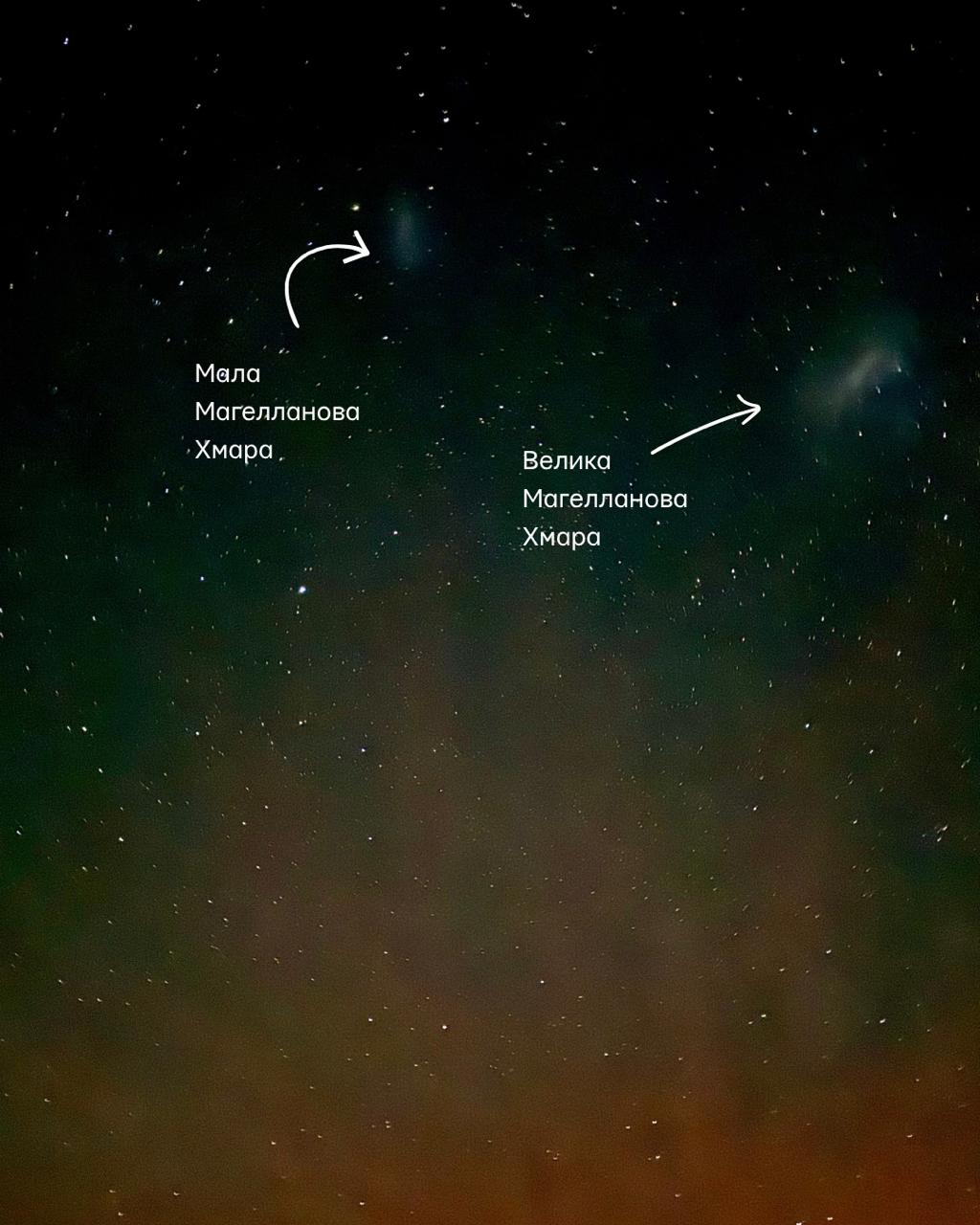
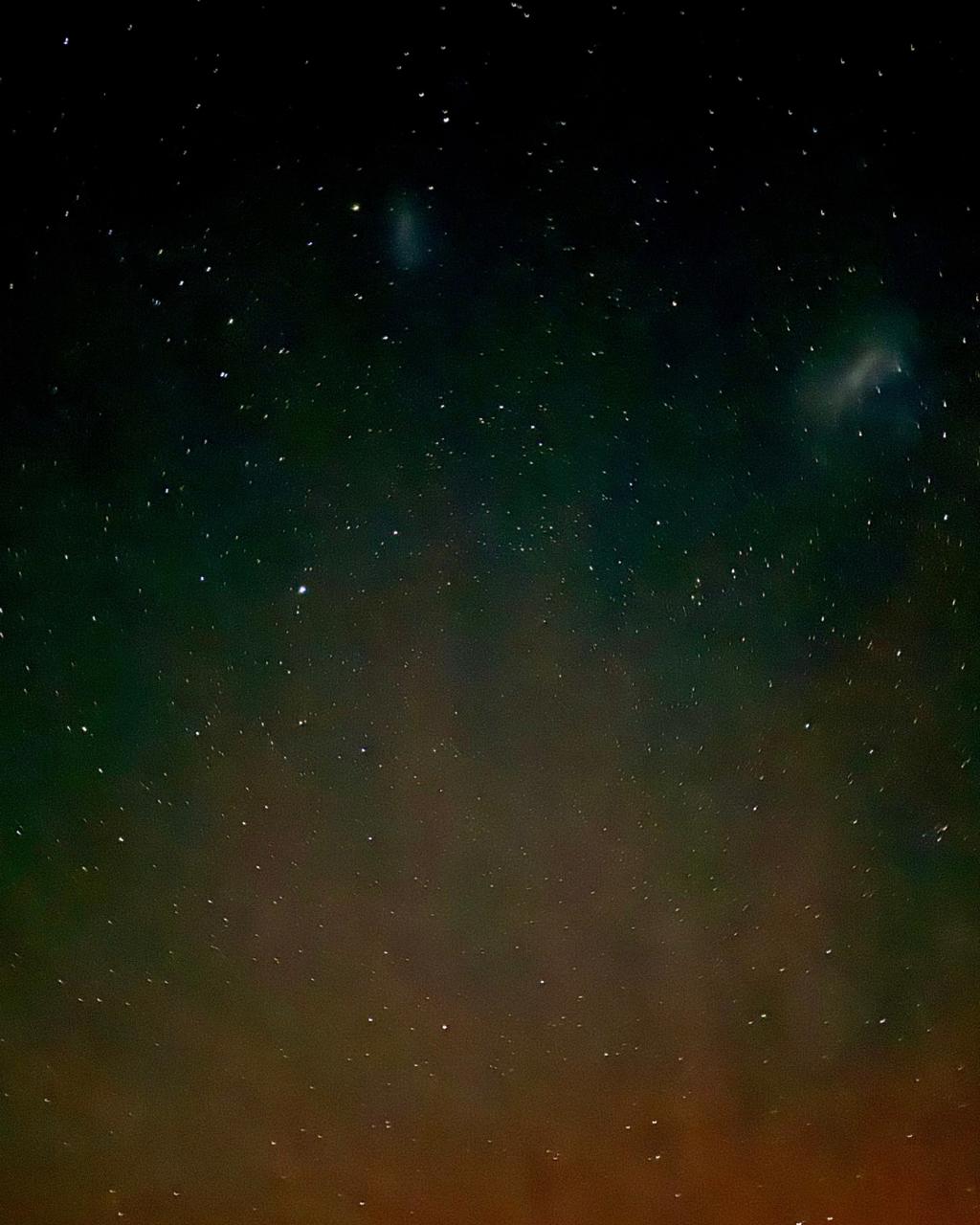
These galaxies became known to Europeans following Ferdinand Magellan’s circumnavigation in the early 16th century, although inhabitants of the southern latitudes had observed them long before. The Persian astronomer al-Sufi referred to the Large Magellanic Cloud as early as the 10th century. In 1987, the supernova SN 1987A exploded within it, becoming the closest supernova observed from Earth in nearly four centuries. It was visible to the unaided eye.
The light captured by the polar explorer’s camera departed from the Large Magellanic Cloud at a time when the earliest members of our species were already living on Earth. The glow above it appeared a fraction of a second before the light entered the lens. Both phenomena were captured in a single frame by a standard camera on an island near the Antarctic Peninsula.
Further information about Antarctica, the lives of Ukrainian polar explorers, and their research is available on the NASC website. This article was jointly prepared by NASC and Universe Space Tech.
