

Uranus and Neptune have long been considered nearly identical twins. They have similar sizes and masses and occupy the outermost reaches of our Solar System. However, an international team of astrophysicists analyzing the composition of their deep atmospheres has uncovered significant chemical differences. The findings, published in Astronomy & Astrophysics, challenge the hypothesis that the two ice giants share a common origin.
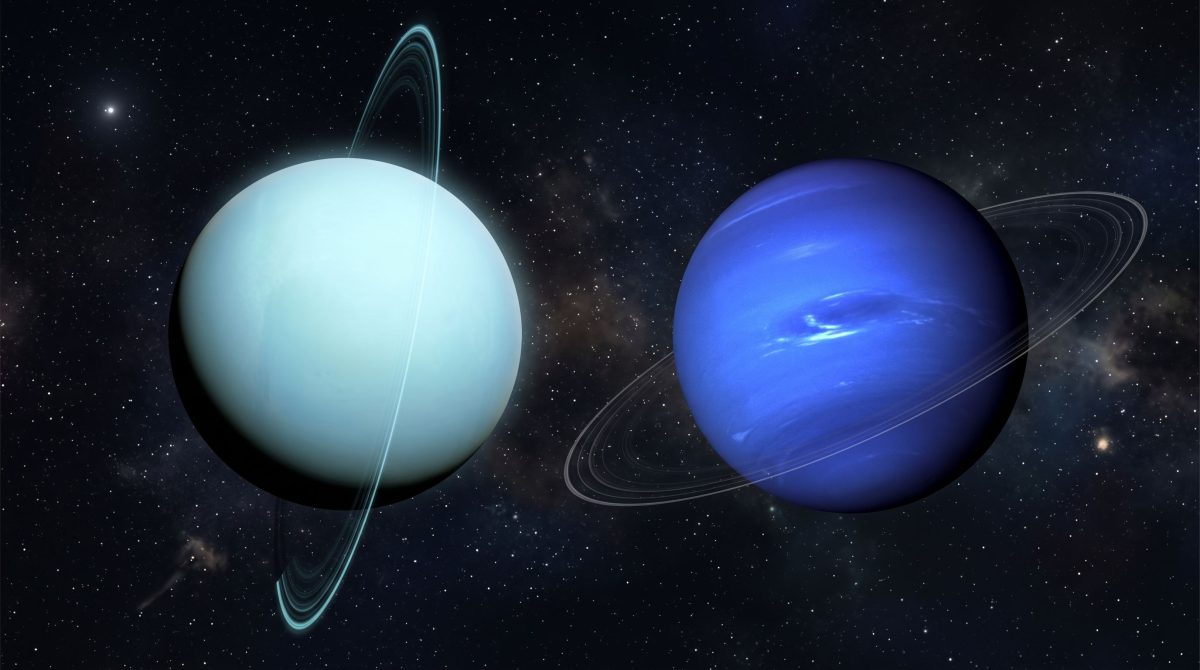
Uranus and Neptune are among the least explored planets in our planetary system: the only spacecraft to fly past them was Voyager 2, in 1986 and 1989, respectively. Their deep interiors cannot be observed directly because of dense, multilayered clouds.
To overcome this obstacle, scientists used carbon monoxide (CO) as a chemical tracer. This gas rises from deep, hot atmospheric layers to altitudes accessible to observations. By combining atmospheric transport models with data from the ALMA radio interferometer, researchers determined the carbon-to-oxygen ratio (C/O) in the interiors of both planets. This ratio serves as a “chemical fingerprint” of the material from which they originally formed.
Neptune Is Richer in Oxygen
Neptune’s atmosphere turned out to be much more enriched in oxygen than Uranus’s. This results in a lower C/O ratio on Neptune. Even accounting for possible uncertainties, such a difference is difficult to explain if both planets formed from the same material in the same region of the protoplanetary disk.
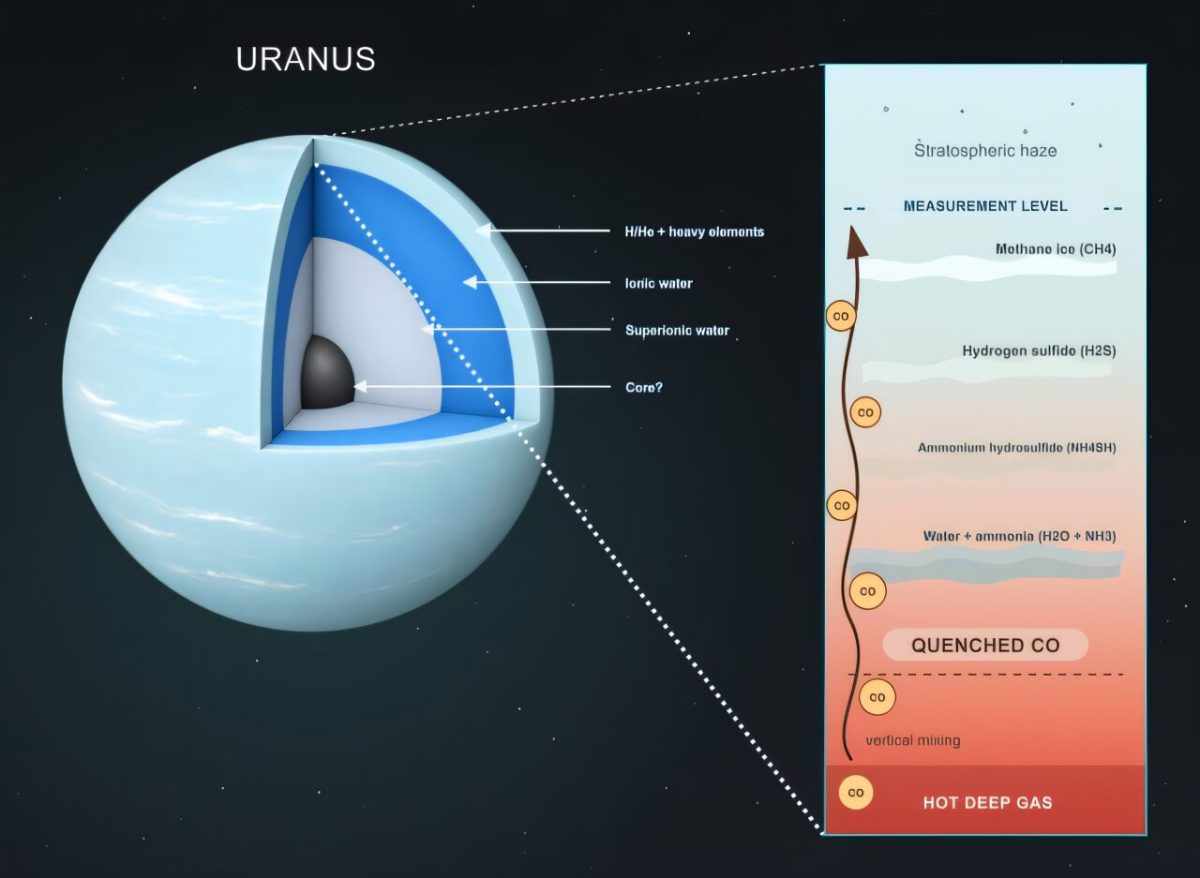
Comparing the findings with models of the early Solar System’s evolution suggests that the planets followed different formation paths:
- Uranus most likely formed far from the Sun, close to its present orbit.
- Neptune may have formed closer to the Sun, where solid material was rich in oxygen, before migrating to the distant outskirts.
Future Missions to the Edge of the Solar System
This picture is not yet definitive, as many uncertainties remain about the vertical circulation of gases deep within the giants. Only new exploratory spacecraft will help resolve these mysteries.
In particular, the Uranus Orbiter and Probe (UOP) mission concept, which the U.S. National Academy of Sciences identified in 2023 as the highest priority for the coming decade, would send a probe directly into Uranus’s atmosphere. Studying these two planets is critically important not only for understanding our own system but also for astrophysics as a whole: planets of similar sizes account for more than half of the nearly 6,000 exoplanets discovered to date.
We previously reported on how Uranus and Neptune turned out to be rocky worlds.
Based on material from phys.org.
