

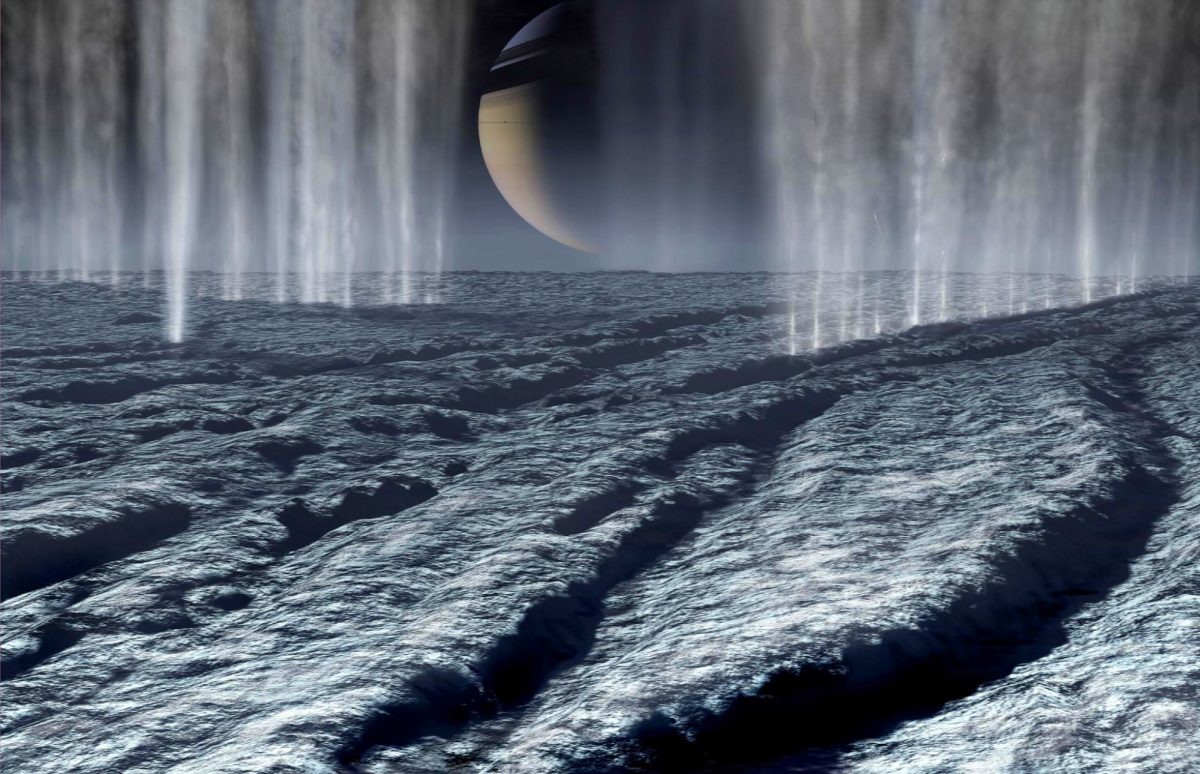
Jets shooting into space near the south pole of Saturn’s moon Enceladus point to an ocean beneath its icy surface. This ocean is salty, and scientists are still debating whether the composition of its salts could reveal the presence of life.
Trapping Water Inside Natron Crystals
The ocean beneath the surface of Saturn’s moon Enceladus lies under kilometers of ice, but some of its components still reach the surface. Jets near the south pole eject water vapor and icy particles, allowing researchers to study the hidden ocean without drilling down to it. The challenge is understanding which materials preserve the most useful clues. A new laboratory study points to a possible target: salt crystals that trap tiny pockets of water as they freeze.
Liam Perera of Diamond Light Source in the United Kingdom and his colleagues found these pockets inside natron, a sodium carbonate mineral expected to form on Enceladus. Their findings, published in Communications Earth & Environment, suggest that the crystals could preserve information about the ocean’s chemistry and possibly traces of life, if any exists there.
To determine which surface mineral would be the best candidate, the team cooled a solution containing sodium chloride and sodium carbonate, using powerful X-rays to watch it freeze. Three-dimensional images revealed the crystals’ growth and internal structure, while measurements of how they scattered X-rays identified the minerals present.
As natron grew, it trapped pockets of the surrounding liquid. Larger crystals were more likely to contain these pockets and generally held larger samples. Only about 3% of nearly 3,800 separate grains contained fluid inclusions, as researchers call them, but all 29 grains in the largest size category did. This makes the crystals potentially useful containers: each pocket could preserve a small sample of the water present when it became sealed.
Although the new experiment shows that natron can trap liquid during freezing, whether it can also capture and preserve biological material remains untested. The authors suggest that the surrounding mineral could help protect any such material from harmful radiation.
Salt Crystals Could Hold Information About Enceladus’s Water
However, a trapped sample would not necessarily be an unchanged droplet of Enceladus’s ocean. The researchers used a solution approximately five times more concentrated than estimates based on particles sampled by NASA’s Cassini spacecraft. This helped produce crystals large enough to study. In this concentrated mixture, large natron crystals began growing before the main body of ice formed, trapping liquid expected to remain close to its original composition.
In a less concentrated, ocean-like solution, ice would probably form first. As it grew, dissolved salts would be left behind, concentrating the remaining water. Natron forming later would trap this saltier liquid.
Both possibilities could provide researchers with useful information: one would offer a more faithful record of the original water, while the other would show how freezing had changed it. The crystals’ shapes and the material surrounding them could help distinguish between these histories. At temperatures typical of Enceladus’s surface, the trapped water would freeze.
Where Should We Look for Natron?
Although natron is a leading candidate for astrobiological research, its presence on Enceladus’s surface has yet to be confirmed. The team recommends equipping future spacecraft with sensitive near-infrared instruments to detect it and guide sample collection.
Fresh deposits near the plume vents could be particularly promising sources. Large droplets cool more slowly, giving crystals time and space to grow; very rapid cooling could prevent natron from crystallizing. The researchers suggest that larger, salt-rich particles are also more likely to fall back near the vents.
Finding the mineral would therefore be only part of the search. Its location and condition would also matter. Natron should remain stable in the moon’s extremely cold conditions, but warmer terrain near the vents could gradually remove water from its crystal structure. Recently deposited crystals could offer the best combination: material brought up from the interior with its microscopic cavities still intact.
